
Emergency Wall Leak In Broomfield Co
Water is coming through your wall right now — streaming, seeping, or bulging the drywall outward — and what is inside that cavity matters enormously: pressurized supply lines, electrical wiring, and insulation that soaks like a sponge. Our emergency wall-leak response pinpoints the in-wall source with listening discs and thermal imaging while the water is still active, so the repair opens one precise cut instead of a wall-wide hunt. Wall-leak emergencies get 24/7 answering and 30–45 minute arrival across Broomfield.
Every emergency button on this page calls us directly — answered 24/7.
Water Spreading Right Now? Call Immediately.
Water streaming from a wall, drywall bulging, or an outlet gone wet? Call now. We will trace the in-wall source acoustically and mark the exact repair cut — arriving in 30–45 minutes, day or night.
(720) 715-9734What Qualifies As A Wall Leak Emergency
Wall leaks turn emergent when water is visibly active, the wall is deforming, or electricity is involved. Call now if any of these match.
Active flow from a wall cavity means a pressurized line has failed inside. The cavity fills, the drywall saturates, and the water finds the floor — this needs same-hour shutoff and tracing.
A bulge is a water balloon made of drywall — it is holding weight and can release suddenly. Keep clear, do not puncture it, and call before it lets go on its own.
Water reaching wiring is a shock and fire emergency, not just a plumbing one. Kill the breaker to that wall immediately if safe, and report it on the call.
A stain that visibly expands means the leak is active and accelerating. Fast acoustic tracing finds the fitting or pinhole before the whole wall section is lost.
A loud hiss with a hot stripe on the wall signals a hot-water line break inside the cavity — scalding water under pressure, saturating insulation rapidly.
Wall Leak Emergency Warning Signs
These urgent wall signatures mean the cavity is actively filling — do not wait for morning.
Bubbles forming and growing in paint or wallpaper show water pushing from behind. The blistering always precedes the breakthrough.
Trim pulling away at the floor line means water is pooling at the cavity’s bottom and wicking outward — the hidden reservoir is substantial.
Warmth plus wetness inside a wall points to a hot supply leak. Hot water degrades drywall paper and feeds mold far faster than cold.
A sharp new musty smell from a wall cavity means trapped water has been there long enough to turn — but the active source still needs finding tonight.
Water emerging at the base of a single wall, with the rest of the floor dry, traces straight back to an in-wall source. The line between wet and dry is the clue.
What To Do Before Help Arrives
Four moves that protect your home and your safety while we roll.
- Shut The Main Water Valve: Closing the house main stops the pressurized feed into the wall cavity. If you can isolate just the affected bathroom or zone, even better — tell our dispatcher what you shut.
- Kill The Breaker To That Wall: If any outlet, switch, or fixture is on the wet wall, switch off its breaker. Do not touch wet outlets or switches, and do not assume the circuit is dead until checked.
- Do Not Puncture The Bulge: Draining a bulging wall yourself releases water unpredictably — often onto flooring, electronics, or you. Let us locate the source first; controlled drainage follows the diagnosis.
- Contain And Photograph: Towels at the baseboard and a bucket under any drip slow the spread. Photograph the bulge, the wettest areas, and any affected outlets for your insurer and contractor.
Safety Guidance
In-wall water plus household wiring demands genuine caution.
- Wet Wiring Is A Shock And Fire Risk: Water inside a wall cavity reaches wire nuts, boxes, and staples you cannot see. Treat every outlet on a wet wall as live until the breaker is off and verified.
- Bulging Drywall Can Release Suddenly: A saturated bulge can weigh tens of pounds and let go without warning. Keep people — especially children — away from the wall until it is assessed.
- Hot Supply Leaks Can Scald: Water from a failed hot line inside the wall can be near heater temperature where it emerges. Do not touch streaming wall water with bare hands.
- Insulation Hides The True Extent: Wet insulation wicks far beyond the visible stain. Assume the damage zone is larger than it looks, and let moisture mapping define it rather than your eyes.
How We Handle Your Emergency Call
Emergency in-wall work is precise and fast: listen, image, map, mark.
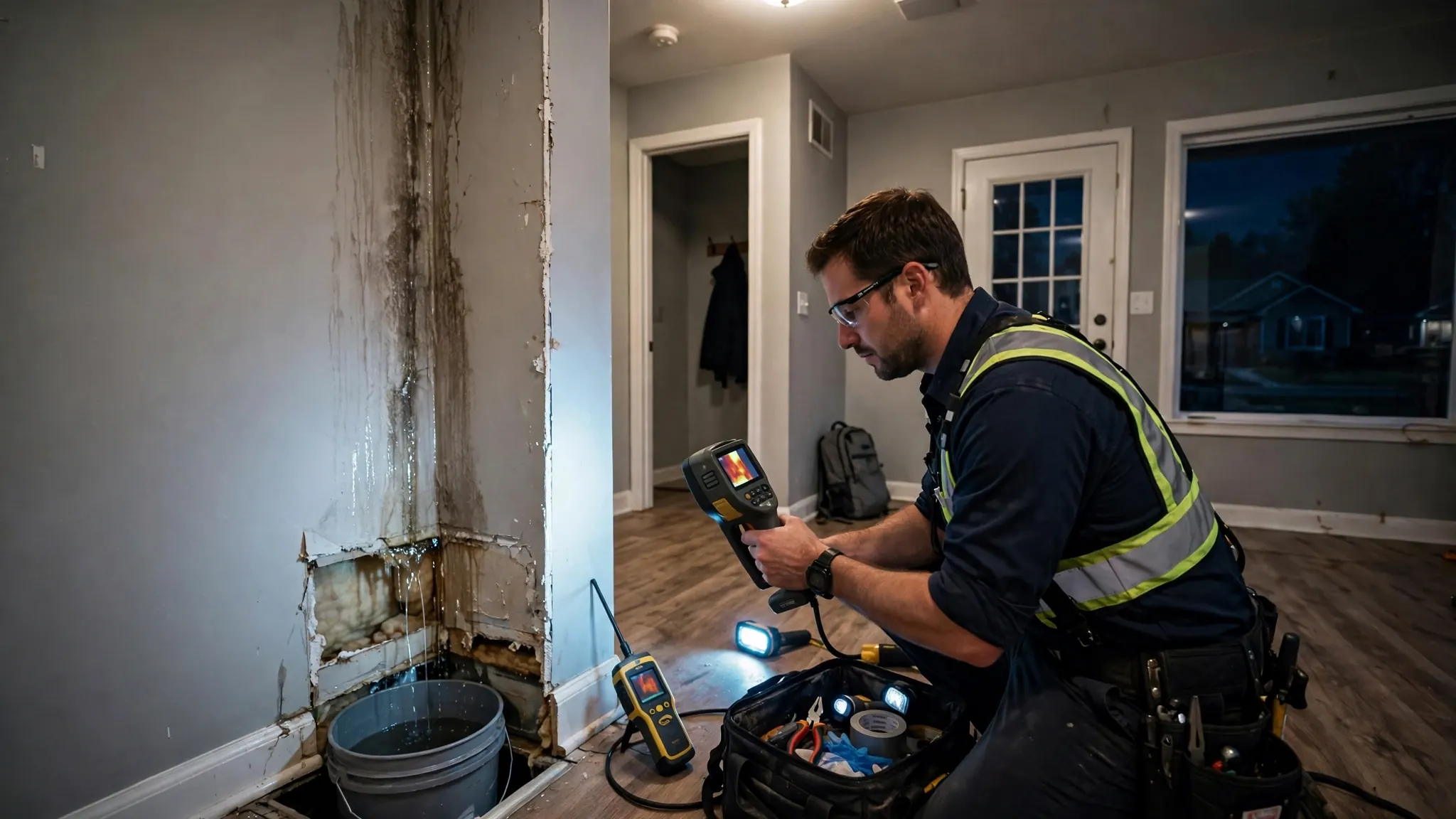
The dispatcher asks about outlets, breakers, and bulging — electrical involvement changes our arrival priorities. The truck rolls with acoustic discs, thermal camera, and moisture meters.
On arrival we verify the breaker is off for the wet wall and confirm the main shutoff held. No instrument work begins in an electrified wet cavity.
Listening discs trace the hiss to the exact stud bay; thermal imaging cross-checks the temperature signature. Two instruments must agree before we mark — even under time pressure.
Meters map how far the saturation traveled beyond the source. The repair cut is marked precisely, and you receive photos plus a written summary for your contractor.
What Happens Next
With the source marked and the water stopped, the emergency is over and the repair is straightforward: your contractor opens the marked section — typically a single stud bay — replaces the failed fitting or pipe section, and restores the drywall. Share our moisture map so they also replace any insulation that wicked water beyond the visible stain; trapped wet insulation is tomorrow’s mold claim.
File with your insurer promptly, attaching our report and your timestamped photos — sudden in-wall pipe failures and their resulting damage are commonly covered. Run fans and dehumidification on the opened cavity after repair until moisture readings normalize. And remember the lesson this wall taught: know your main shutoff and your breaker panel before the next emergency, not during it.
Related Standard Service
Not an emergency? Our standard diagnostic page covers the same service in non-urgent detail.
Related Emergency Services
Water traveled up or the ceiling is sagging too? Emergency ceiling source-tracing with collapse-risk assessment, 24/7.
Explore Emergency Leak Detection In Broomfield CoSource unclear and water spreading? Emergency whole-property triage with full instrument kit, day or night.
Explore Emergency Slab Leak In Broomfield CoWet at the wall’s base and the slab below? Emergency thermal slab pinpointing before flooring is lost.
ExploreEmergency Wall Leak Across Broomfield
Emergency wall-leak response runs 24/7 across Broomfield. In-wall failures do not wait for business hours — our acoustic and thermal crews reach every neighborhood below within 30–45 minutes.
- Downtown / City Center, CO
- West End, CO
- Heritage Hills, CO
- Fairview, CO
- Sunnyside, CO
- Highland Park, CO
ZIP Codes We Serve
80020, 80021, 80023, 80038 — our emergency coverage includes all of Broomfield's ZIP codes.
See the full picture on our emergency leak detection hub.
Emergency Wall Leak Questions, Answered
Shut your main water valve, kill the breaker to that wall if any outlet or switch is on it, and call (720) 715-9734. Answered 24/7; we reach wall-leak emergencies in 30–45 minutes. Do not puncture a bulging section — we trace the source acoustically first, then mark the precise repair cut.
It can. A saturated drywall bulge holds significant water weight and may release suddenly. Keep everyone clear of it, do not poke or drain it yourself, and call now — we prioritize bulging walls on emergency dispatch.
Yes — treat it as an electrical emergency first and a plumbing emergency second. Switch off the breaker to that wall if you can do so safely, do not touch the outlet, and tell our dispatcher. We verify power is isolated before any instrument work begins.
Yes. We are open now, 24/7, across all of Broomfield — nights, weekends, holidays. In-wall emergencies get the same 30–45 minute arrival as any urgent call.
No — detection and repair are separate. Our emergency job is to pinpoint the exact source and mark the repair cut, usually a single stud bay, with moisture mapping showing the full saturation zone. Your contractor opens only what is marked.
Listening discs pick up the hiss of pressurized water through drywall and trace it to the exact bay; thermal cameras cross-check the temperature signature. When both instruments agree, we mark the spot — no exploratory holes.
A slow seep with a stable stain sometimes can. Active streaming, a growing bulge, or any electrical involvement cannot — water under pressure does not pause overnight, and wet wiring only gets more dangerous. Describe what you see on the call and we will give you a straight answer.
1798 W 6th Ave, Broomfield, CO 80020
Get DirectionsCall Now For Emergency Wall Leak Help
Water inside your wall is a race against saturation — and against the wiring inside it. Call now for emergency in-wall tracing: acoustic pinpointing, a marked repair cut, and full documentation. Open 24/7.